
How it all started…
It is interesting sometimes to tell how we all got interested in cars and working on them. I thought I would share my experiences with you. If you would like to share your “story,” send it to me, and I will post it on my website.
I must have been about 12 or 13 years old, which would have put my younger brother at 11 or 12. We had both taken our bikes apart a few times by then and even painted them once or twice. This was back in the early 60’s in Northern California, and candy apple red was the cool color then. Spraying a layer of gold, then a kind of translucent red on top of that, followed by numerous coats of clear.
We weren’t interested in organized sports that much.. Back then, there was no soccer, just baseball. So, my dad was looking for something he could do with both of us. We camped a lot, and that was fun, and the Sierra Mountains were right there, so we really had some great scenery. Did a bit of hunting too. But then we started getting interested in cars…
Well, my dad came up with a plan…
I can still remember the night my dad brought the Jordan home. We lived on a real steep hill, and it was dark, I remember that.. I was standing in the garage, and luckily, the garage door was open. I think I was working on something, probably my bike. I could hear what sounded like a chain dragging down the street up the hill from us, and I stopped what I was doing and walked out to the end of the driveway. All of a sudden, this huge old car turns into the driveway and rolls into the garage. That first car started a parade of several antique cars that we restored over the years.
Our dad had bought a 1925 Jordan Brougham sedan. It was huge.. Big wooden spoke wheels with fat tires on them. I later found out they were referred to as Balloon tires. It had been partially taken apart, but it was all there. Jordan’s were made in Cleveland, Ohio, from about 1916 till about 1931. All totalled, I think they made about 1,000 cars. They had some advanced features for 1925, like 4-wheel hydraulic brakes. It had a big old Continental straight 8 cylinder motor that had endless amounts of torque. Continental was well known at the time for manufacturing aircraft engines. Those brakes worked pretty well, too, as long as you remembered to pump up the residual pressure every once in a while.
By the time we finished that first car, I knew quite a bit about how cars were put together, especially for a 12-13-year-old. I remember doing a project for school where I had to do a presentation, and I identified and explained all the parts of an engine, much to the amazement of my teacher at the time. There were some interesting stories along the way..
I remember when we got the engine back together and were trying to start it for the first time. The big Continental straight 8 had poured babbitt main and connecting rod bearings that were extremely tight when new. In fact, they were so tight that we had to use the electric starter and the hand crank to get the motor turning over fast enough to start that first time.
My dad manned the crank, and I was instructed on what to do in the driver’s seat. On top of the steering wheel were two levers. The left one advanced and retarded the spark. I remember up was retarded, and down was advanced. The right-hand lever actually controlled the throttle. It was intended to allow you to open the throttle slightly while hand cranking the engine so you could give it a little gas to start it up.
The engine had these little brass cups on the cylinder head, one over each piston. You could prime the engine with gas by filling the cups, then opening them a quarter turn counter-clockwise to let the gas drop down into the cylinders.
So, there I sat in front of the steering wheel with that long hood in front of me as I watched my dad carefully fill and drain all 8 priming cups into the engine. He came back to me and made sure the car was in neutral and told me ‘Whatever you do, don’t move the gear shift’. Then he walked around to the front and grabbed the crank sticking out of the radiator.
I watched the fan move as he pulled the crank to get it around to a good position. When he was ready, he said, “OK, now retard the spark all the way”. I pushed the spark lever all the way up. Next, Dad said to turn on the ignition, and I pulled a lever on the dashboard. There was no key in the ignition, but there was a lock on the bottom of the gearshift. Anyway, dad said to put my foot on the starter button, and the starter came to life. It cranked and cranked, but nothing happened.
Finally, my dad stopped cranking and just placed his head on the radiator to rest. I went upstairs to get us a cold drink.
By the time I got back, dad had taken the distributor cap off and checked for spark, and that was OK. There was plenty of gas, so what was the problem?
Well, while we were drinking our pop, he asked me to show me what I did. I pushed up the spark lever and turned on the ignition, and he laughed and told me to stop right there.. I was turning on the headlights!! Since we had the headlights off, being re-chromed, we had no idea.. Dad reached across me to the real ignition switch and pulled it out. I was watching him, but I noticed the engine fan turn just slightly, almost like a flinch. We both smiled, and Dad walked around to the front of the motor again and said, ‘I think this will be the one”.
I think it started before Dad got one complete revolution. My brother and I were so excited, you would have thought we invented the motor car! I ran upstairs to tell my mother that the motor ran, and all she saw were the footprints on her new carpet!
There were other problems to solve, like getting those hydraulic brakes working, and then there was the vacuum fuel pump that was popular back then. We kept that car for quite a while and had many happy hours working on it. It was always very relaxing, the three of us down in the garage. My dad had an old FM radio we used to listen to classical music on, his choice, not mine, but I still do that sometimes now, just out of respect…
Here is the carburetor side of the motor.
That silver tank on the firewall is the vacuum tank fuel delivery system.
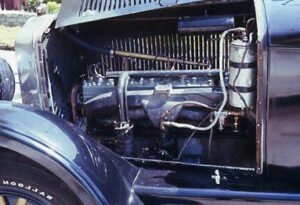
It had a smaller tank inside with a float valve similar to a carburetor float valve, only this one controls suction from the fuel tank in the rear of the car to the inner tank in the device. The theory was that as long as there was sufficient vacuum (not loading the engine too much) gas could be sucked up into the tank and gravity would feed it to the carburetor. It worked fine until you went up a long, steep hill, like the one we lived on.
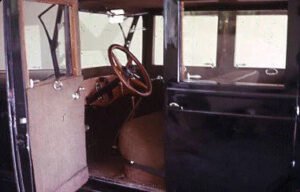
Here is the inside. You can just make out the two silver levers on top of the steering wheel for spark advance and throttle.
I really like this color too, it is what I am going to paint my TR4A.
Well, that’s how I got interested in cars.
What’s your story?